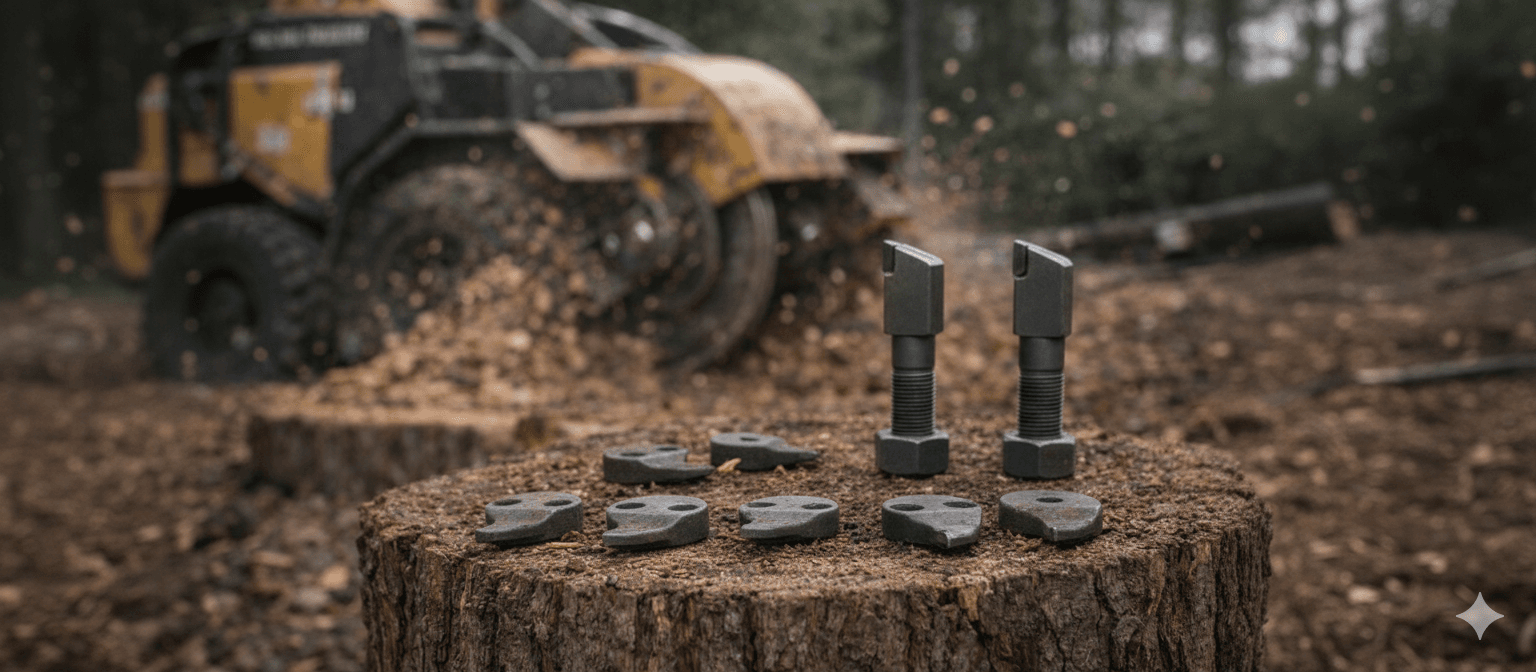
In stump grinding, performance differences rarely come from what is immediately visible. Machines appear comparable. Operators follow similar best practices. Pricing often sits within a narrow range. And yet, results diverge; sometimes quickly, sometimes dramatically. Downtime increases. Tool changes accelerate. Productivity becomes inconsistent. Margins begin to compress.
In most cases, the underlying cause is not the machine, the crew, or the workload. It is the quality of tungsten carbide embedded in the cutting teeth, an input that is rarely scrutinized closely, yet increasingly decisive for professional outcomes.
As global material dynamics shift and cost pressures intensify, tungsten carbide quality has moved from a technical detail to a strategic variable. This shift sits at the center of today’s stump grinding market and explains why StumpTeeth was built for this moment.
Tungsten Carbide: A Strategic Material Under Pressure
Tungsten carbide is not a commodity in the traditional sense. It is produced from tungsten ore, a material classified as critical by multiple governments due to its economic importance and supply risk.
According to the U.S. Geological Survey, global tungsten supply remains highly concentrated, with China responsible for the majority of mining and refining capacity. This concentration exposes downstream industries to geopolitical risk, export controls, and price volatility.
Over the past several years, these risks have intensified. Demand for tungsten carbide has grown across mining, construction, defense, energy, and infrastructure sectors, each of which relies on its extreme hardness and wear resistance. At the same time, environmental compliance costs and processing constraints have increased.
The result is structural upward pressure on tungsten carbide prices worldwide.
For stump grinding professionals, this matters because carbide is not a marginal input. It defines cutting efficiency, wear life, vibration behavior, and ultimately job economics.
How Rising Costs Change Manufacturing Decisions
When the cost of a critical raw material rises, manufacturers face a strategic decision. Research from McKinsey & Company shows that companies typically respond in one of three ways: increase prices, accept margin compression, or redesign products to reduce material costs.
In the stump grinding market, redesign has increasingly meant internal material substitution rather than visible engineering changes. Carbide content is adjusted in ways that are difficult to detect without metallurgical analysis.
Common responses include reducing carbide density, altering grain structure, lowering cobalt binder content, or introducing recycled and blended powders with inconsistent properties. These choices preserve short-term pricing but fundamentally change how a tooth behaves under load.
From the outside, the product may appear unchanged. In the field, the difference becomes obvious.
Why Stump Grinding Exposes Material Quality Faster than Most Applications
Stump grinding is one of the most demanding real-world environments for carbide tooling. Each tooth is subjected to repeated high-impact loads, abrasive soil, hidden rocks, and continuous vibration. Thermal cycling and shock loading are the norm, not the exception.
Lower-grade carbide does not degrade gracefully in these conditions. Instead, it tends to chip, crack, or lose its cutting edge rapidly. Wear accelerates unevenly, increasing vibration and stress on both the machine and the operator. Tooth changes become more frequent. Downtime becomes unpredictable.
Quality compromises in industrial components often reveal themselves not in unit cost, but in system-wide inefficiencies such as downtime, maintenance, and lost productivity.
In stump grinding, those inefficiencies translate directly into lost hours and higher operating costs.
Cost Per Tooth vs. Cost Per Hour
Professional stump grinding operations do not compete on consumable prices alone. They compete on reliability, throughput, and the ability to complete jobs predictably.
A tooth that costs less upfront but wears out significantly faster does not reduce expenses. It increases the frequency of changeovers, raises labor and fuel costs, and introduces scheduling risk. Over time, it also accelerates wear on other machine components due to increased vibration.
This is why leading operators increasingly evaluate tooling based on cost per hour of grinding, not price per unit.
Industries facing input volatility are shifting decisively toward total cost of ownership models, recognizing that apparent savings at purchase often mask higher lifetime costs.
In stump grinding, carbide quality is one of the strongest predictors of total cost of ownership.
What High-Quality Tungsten Carbide Actually Looks Like
High-performance stump grinding teeth rely on cemented tungsten carbide engineered specifically for impact resistance. This typically involves a tungsten carbide–cobalt (WC-Co) structure with controlled grain size, density, and binder content.
Coarser grain carbide improves fracture toughness, while properly balanced cobalt content provides resistance to shock loading without sacrificing wear life. Consistent density ensures predictable, uniform wear rather than sudden failure.
Research shows that small variations in the microstructure of WC–Co cemented carbides (such as changes in grain size and cobalt content) can significantly affect mechanical properties like fracture toughness and wear resistance, especially under demanding conditions.
In stump grinding, those differences are not theoretical. They determine whether a tooth maintains stable performance across dozens of hours, or fails prematurely.
A Market at an Inflection Point & StumpTeeth’s Position Within It
The stump grinding market is entering a decisive phase. Rising tungsten carbide prices are forcing both manufacturers and operators to reassess long-standing assumptions about tooling economics.
Some suppliers prioritize short-term price stability. Others focus on long-term performance consistency. StumpTeeth was built around the latter approach.
The carbide used in StumpTeeth products is selected to withstand the realities of professional stump grinding: abrasive environments, unpredictable impacts, sustained heat, and continuous vibration. That focus remains constant regardless of market cycles or raw material volatility.
As material pressures increase, the performance gap between high-integrity carbide and compromised alternatives becomes increasingly visible in the field. Teeth either maintain cutting stability over time, or they don’t. Wear remains controlled, or it accelerates. Downtime stays predictable, or it spreads unpredictably across operations.
In this environment, carbide quality is no longer a secondary specification. It has become a primary driver of reliability, productivity, and operating cost.
Why Carbide Quality Still Decides Outcomes
When a stump grinding tooth appears unusually inexpensive, the cost has almost always been reduced somewhere beneath the surface. The consequences may not be immediate, but they are inevitable.
The real question facing professional operators today is no longer simply the price per tooth. It is the cost per hour of grinding, measured across uptime, performance consistency, and service life.
Tungsten carbide quality still matters. In today’s market, it matters more than ever.
If your organization is ready to modernize its approach to stump grinding performance, reliability, and total cost of ownership, call us directly at (512) 500-0075 or contact us online and discover why professionals across the U.S. are choosing carbide built for real-world conditions.
Fast delivery is guaranteed: orders placed by 2 pm CT ship the same day, with next-day options available.