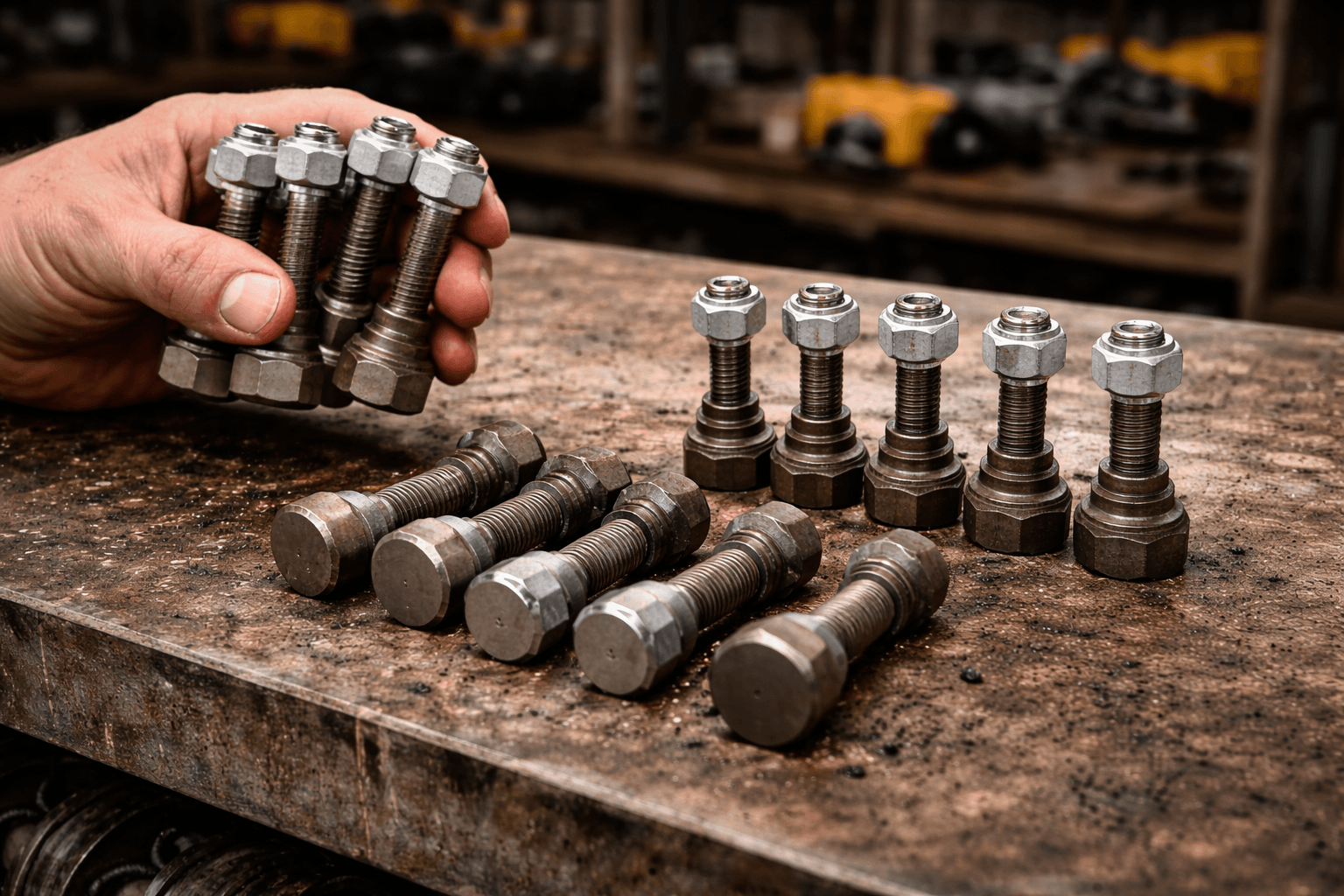
Discover why lower upfront prices often lead to higher long-term expenses in stump grinding operations.
In the tree service industry, profitability is rarely determined by the obvious numbers. Equipment looks solid. Crews are skilled. Schedules are full. On the surface, operations appear efficient.
Yet margins quietly tighten.
Jobs take slightly longer than expected. Fuel consumption creeps upward. Teeth need rotating more often than planned. Small interruptions accumulate across weeks and months.
Nothing feels dramatic. But performance is gradually eroding.
For many contractors, the source of this erosion can be traced back to a single purchasing decision: choosing cheaper stump grinder teeth in the name of cost savings.
At first glance, the logic seems sound. Teeth are consumables. They wear out. Why pay more?
But in high-utilization equipment environments, the cheapest component is often the most expensive variable in the system.
This is the hidden reality behind the debate over cheap vs. premium stump grinder teeth and why upfront price rarely reflects true operational cost.
The Seduction of the Lower Price Tag
In industries built on equipment utilization, operators constantly seek ways to protect margins. Teeth are consumables. They wear out. They must be replaced. It is tempting to treat them as interchangeable.
Lower-cost options can be significantly cheaper upfront—sometimes noticeably less per tooth compared to premium engineered alternatives. On a full wheel, the difference feels meaningful. Multiply that across several grinders, and it appears even more compelling.
But this mindset focuses on procurement cost, not operational cost.
McKinsey research highlights that leading procurement organizations focus on total cost of ownership and lifecycle performance rather than simply minimizing purchase price, and that this broader approach correlates with stronger operational outcomes and higher profitability across capital-intensive functions.
Stump grinder teeth sit precisely in that category.
Performance Is a Revenue Variable
A stump grinder generates income only when it is cutting efficiently. Every reduction in cutting speed directly affects cost per job and total daily output.
Lower-cost teeth often rely on less refined carbide composition and simplified manufacturing processes. The difference may not be visible on day one. It becomes visible over time:
- Edges dull faster
- Carbide tips chip under impact
- Heat buildup increases
- Vibration intensifies
Grinding speed can gradually decline. The machine requires more passes. Operators apply more pressure. Fuel consumption increases incrementally.
Research highlighted by Harvard Business Review shows that organizational inefficiencies and operational friction compound over time, eroding productivity and profitability at scale. What may appear to be minor slowdowns in isolation can generate significant financial impact when repeated across weeks, months, and high-utilization operations.
In stump grinding, that decline often originates at the tooth.
The Hidden Weight of Downtime
Downtime is one of the most underestimated expenses in field operations.
When teeth wear prematurely, crews must stop to rotate or replace them. While a single service interruption may take less than an hour, its ripple effects extend far beyond the mechanical adjustment:
- Labor remains on payroll
- Equipment sits idle
- Subsequent jobs are compressed
- Customer schedules shift
In high-demand seasons, lost hours cannot always be recovered. They simply disappear from potential revenue.
Industry research highlights that unplanned operational interruptions can incur very high costs, particularly in capital-intensive contexts where uptime directly influences revenue and productivity. For example, studies referencing Gartner’s estimates find that the cost of downtime can reach significant figures per hour for larger organizations, reinforcing that interruptions often cost disproportionately more than the component replacements that precipitate them.
Cheap teeth rarely fail catastrophically. Instead, they degrade performance until productivity erodes quietly.
Replacement Frequency & Operational Friction
The difference between inexpensive and premium stump grinder teeth often lies in longevity.
Lower-cost options may require noticeably more frequent rotation or replacement. Premium alternatives, built with higher-grade carbide and reinforced steel bodies, tend to maintain cutting integrity longer under similar conditions.
Over the course of a busy season, that difference translates into:
- Fewer wheel service intervals
- Reduced mechanical strain
- Lower cumulative labor interruptions
- More consistent cutting performance
Each replacement event introduces friction into operations. Crews break rhythm. Momentum slows. Even small inefficiencies multiply over hundreds of grinding hours per year.
When evaluating stump grinder cost per hour, these factors matter more than per-tooth pricing.
Material Science Is Not Marketing
Premium stump grinder teeth are not simply higher-priced versions of the same product. Their performance advantage is rooted in engineering.
Higher-density carbide formulations improve edge retention. Precision brazing reduces the risk of tip separation. Hardened steel bodies absorb shock from rocks and buried debris. Balanced design minimizes vibration, protecting bearings and wheel assemblies.
Lower-cost imports frequently reduce manufacturing complexity to control price. That often means softer steel bodies, less refined carbide mixtures, and less rigorous quality control.
The consequences are predictable:
- Faster dulling
- Increased micro-chipping
- Greater vibration
- Accelerated wear on adjacent components
What appears as a consumable cost decision gradually becomes a maintenance cost multiplier.
Fuel, Wear & the Efficiency Equation
A dull cutting edge demands more energy. Operators compensate instinctively: more throttle, more pressure, longer passes.
The U.S. Department of Energy has repeatedly demonstrated in industrial contexts that inefficient cutting systems increase energy consumption due to friction and resistance. While stump grinders operate in a different environment, the physics are identical: resistance increases load.
In practical terms, this can mean:
- Incrementally higher fuel usage
- Elevated hydraulic strain
- Greater bearing stress
- Shortened service intervals
Individually, these effects seem minor. Collectively, they reshape operational economics.
Premium teeth do not merely cut faster; they help preserve the machine’s designed efficiency.
Reputation & Reliability
Operational performance is not only a cost factor; it is a brand factor.
When grinding takes longer than expected, homeowners notice. Extended noise exposure and repeated repositioning can create frustration. In competitive U.S. markets, online reviews carry significant influence over purchasing decisions.
A contractor who consistently completes stump removals quickly and cleanly builds trust. One who struggles with slow, uneven grinding risks reputation erosion.
Premium performance becomes a competitive differentiator, not simply an internal cost control measure.
Rethinking “Value” in Grinder Teeth
Value is often misunderstood as “lowest price.” In professional operations, value is better defined as:
- Durability over time
- Predictable performance
- Reduced operational interruptions
- Protection of equipment
- Consistent job completion speed
Premium stump grinder teeth typically carry a moderately higher upfront price. However, their longer lifespan, stability, and efficiency frequently result in a lower effective cost per hour of grinding.
When operators analyze performance holistically (rather than per invoice) the equation shifts.
The real comparison is not cheap vs. expensive.
It is unstable vs. consistent. Reactive vs. predictable. Short-term savings vs. long-term profitability.
The Strategic Operator’s Advantage
Across industries, companies that outperform competitors rarely do so by cutting quality inputs. Instead, they optimize systems.
In stump grinding, teeth are not peripheral accessories. They are the mechanical interface between horsepower and hardwood. Their design influences:
- Grinding speed
- Fuel efficiency
- Machine longevity
- Crew productivity
- Customer satisfaction
Premium-grade teeth engineered for durability and precision contribute to smoother operations and stronger margins over time.
For contractors searching for the best grinder teeth value, the real metric is not the lowest advertised price—it is consistent high performance across hundreds of hours in the field.
Upgrade Your Grinder with Precision Teeth
The efficiency of a stump grinder is determined not by horsepower alone but by the sharpness, durability, and design of its teeth. Contractors who continue to view grinder teeth as interchangeable consumables risk higher costs, slower performance, and competitive disadvantage. Those who invest in premium, properly engineered components build reliability and long-term profitability into their operations.
We combine the highest-quality materials on the market with the most competitive prices available, delivering exceptional value without compromise.
Call us directly at (512) 500-0075 or contact us online and discover why professionals across the U.S. are choosing carbide built for real-world conditions.
Browse our products today.
Fast delivery is guaranteed: orders placed by 2 pm CT ship the same day, with next-day options available.