The Hidden Cost of “Good Enough”
In industries built on precision and performance, there’s a quiet divide between operations that consistently outperform and those that struggle to keep up. At first glance, they often look the same—similar equipment, comparable teams, and access to the same tools. Yet over time, the gap widens.
The difference rarely comes down to effort. More often, it lies in decision-making—specifically, in how organizations approach maintenance.
Across sectors, from manufacturing to forestry, maintenance is traditionally viewed as a cost center: something to manage, minimize, and control. But leading organizations are beginning to see it differently. Companies that adopt advanced maintenance strategies can reduce costs by up to 20% while increasing productivity by as much as 25%.
This shift requires a fundamental mindset change. Maintenance is no longer just about preserving equipment, it’s about optimizing performance.
Nowhere is this more evident than in a seemingly simple but critical question: when should you stop sharpening and start replacing?
The Illusion of Endless Sharpening
Sharpening feels like the responsible choice. It’s economical, immediate, and aligns with the instinct to extend the life of every component. In many cases, it’s absolutely the right decision.
But like many operational habits, it can become automatic—applied without questioning whether it still delivers value.
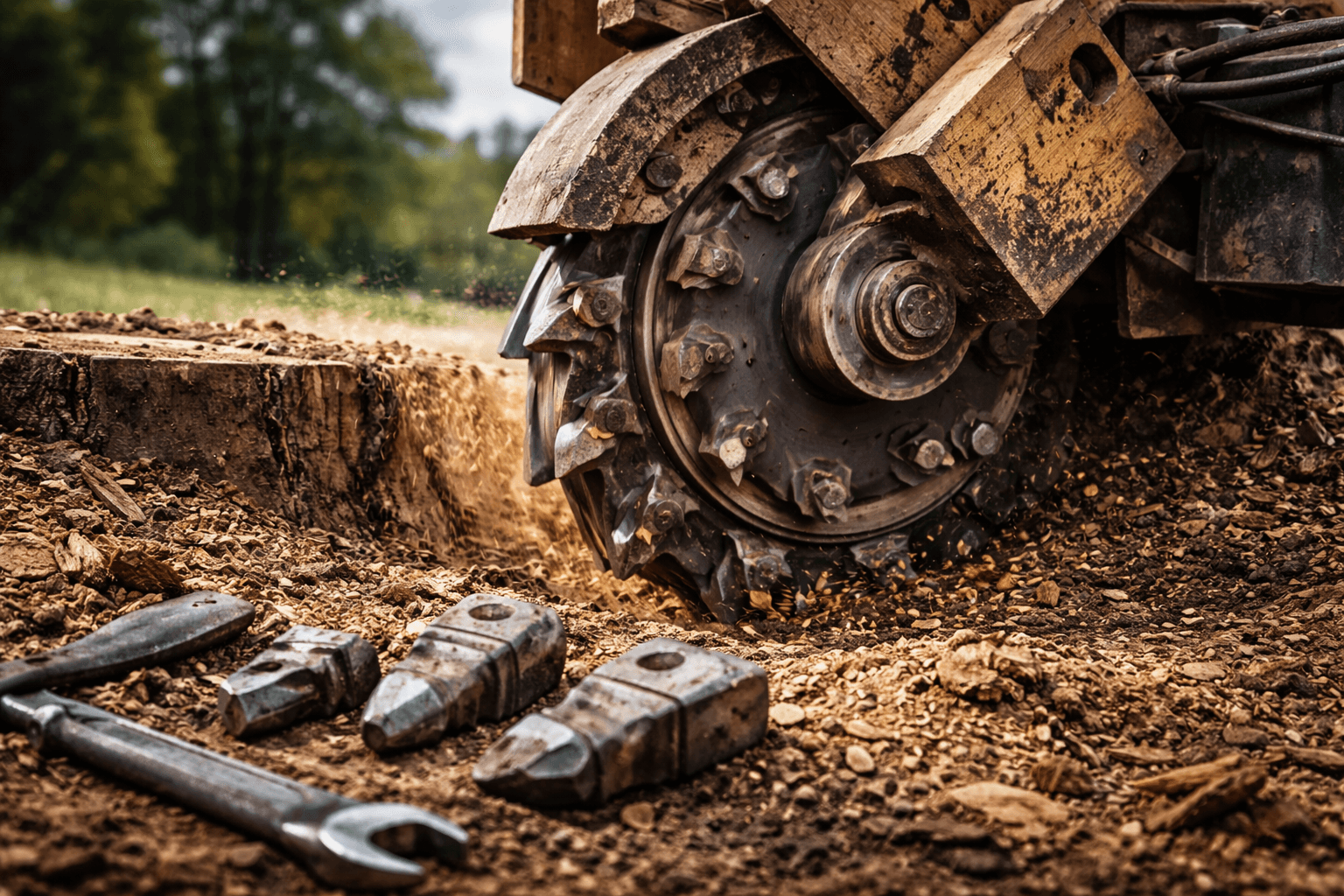
Each sharpening cycle removes material. With stump grinder teeth, especially those tipped with carbide, this means gradually altering the geometry that was engineered for optimal cutting efficiency. Over time, even a perfectly sharpened tooth may no longer perform as intended.
Harvard Business Review has explored this phenomenon in broader operational contexts, identifying “over-maintenance” as a hidden risk—where excessive intervention degrades performance instead of improving it.
In practical terms, this creates a paradox: the more you sharpen, the less effective the tool can become.
Reading the Signs: What Wear Really Looks Like
Experienced operators often rely on instinct, but the most effective decisions are grounded in observable patterns.
Wear doesn’t happen all at once, it reveals itself gradually.
At first, the cutting edge begins to lose its original shape. The sharp, defined angles soften into rounded surfaces. This subtle change affects how the tooth engages with the material, reducing cutting efficiency even if the edge still feels sharp to the touch.
Then come micro-fractures—tiny cracks in the carbide that may not be immediately visible but compromise structural integrity. The National Institute for Occupational Safety and Health (NIOSH) has documented how repeated stress can lead to material fatigue in industrial components.
Finally, there is carbide fatigue itself: a stage where the material simply cannot hold an edge effectively anymore. At this point, sharpening becomes a temporary fix rather than a solution.
The key insight is this: sharpness alone is not a reliable indicator of performance.
The Hidden Economics of Over-Sharpening
From a distance, sharpening appears cost-effective. But a closer look reveals a more complex equation.
Gartner notes that organizations focusing solely on immediate cost savings often increase their total cost of ownership by up to 30% due to inefficiencies and downstream impacts.
In the context of stump grinding, over-sharpening can lead to:
- Reduced lifespan of each tooth
- Increased machine vibration
- Higher fuel consumption
- Accelerated wear on critical components
These effects compound over time, quietly eroding profitability.
The real cost of over-sharpening isn’t measured in dollars per tooth—it’s measured in lost productivity, increased downtime, and equipment strain.
Balance Matters: The Overlooked Factor
Beyond individual tooth performance, there’s a system-level consequence that often goes unnoticed: balance.
When teeth are sharpened unevenly—some more frequently than others—the cutting wheel becomes unbalanced. Even minor discrepancies can have significant effects at high rotational speeds.
The U.S. Department of Energy has highlighted how small imbalances in rotating equipment can lead to increased vibration, reduced efficiency, and higher maintenance costs.
For stump grinders, this translates into:
- Inconsistent cutting patterns
- Greater mechanical stress
- Reduced operator control
In other words, improper sharpening doesn’t just affect the teeth, it affects the entire machine.
Knowing When to Replace: A Practical Perspective
There is no universal replacement schedule, but there are consistent indicators that signal when sharpening is no longer enough.
Operators working in clean, controlled environments may extend the life of their teeth through multiple sharpening cycles. Those operating in abrasive conditions—rocky soil, sand, or debris—will reach the replacement threshold much sooner.
Common signs that replacement is the better option include:
- Significant reduction in carbide size
- Noticeable decline in cutting speed
- Increased need for applied pressure
- Unusual vibration during operation
Forbes emphasizes that high-performing organizations rely on data-driven decision-making rather than habit or assumption.
Applying this principle means tracking performance metrics—cutting time, fuel usage, and machine behavior—to determine the optimal moment for replacement.
From Reactive to Predictive Maintenance
The most advanced operations are moving beyond the sharpening-versus-replacement debate altogether.
Instead, they are adopting predictive maintenance strategies using data and technology to anticipate when performance will decline.
McKinsey highlights that predictive maintenance can reduce breakdowns by up to 70% and lower maintenance costs significantly.
In the stump grinding industry, this approach is gaining traction. Monitoring vibration patterns, tracking usage cycles, and analyzing performance trends can provide early signals that a tooth is nearing the end of its effective life.
This shift transforms maintenance from a reactive task into a strategic advantage.
A Shift in Mindset
Ultimately, the decision to sharpen or replace is not merely technical, it’s philosophical.
It requires moving away from the idea of “getting the most out of every part” and toward “getting the best performance out of every operation.”
Organizations that make this shift don’t just maintain equipment, they optimize it.
As highlighted by the Retail Industry Leaders Association (RILA), resilience and performance are driven by efficient processes and informed decision-making.
In this context, replacement is not a failure of maintenance—it is a deliberate choice to sustain performance.
The Cost of Waiting Too Long
The gap between average and high-performing operations is rarely the result of dramatic changes. More often, it’s shaped by small, consistent decisions made over time.
Choosing to keep sharpening when replacement is needed is one of those decisions.
It’s easy to delay. To squeeze out one more cycle. To justify the choice based on short-term savings. But in doing so, many operations unknowingly trade efficiency for inertia. In today’s competitive landscape, where margins are tight and expectations are high, that trade-off is no longer sustainable.
The question is no longer whether a tooth can be sharpened again. The question is whether it should be.
If your organization is ready to modernize its maintenance approach, improve operational efficiency, and eliminate hidden costs, now is the time to act. Explore StumpTeeth’s range of replacement teeth and take the next step toward peak performance.
Call us directly at (512) 500-0075 or contact us online and discover why professionals across the U.S. are choosing carbide built for real-world conditions.
Browse our products today.
Fast delivery is guaranteed: orders placed by 2 pm CT ship the same day, with next-day options available.